Website Refresh / Redesign Playbook.
Your website should be helping your business grow. This playbook walks through how to evaluate it, decide what kind of project it needs, and find the right partner for the job. Built by Shore's Portfolio Performance Group with vetted partners.
Inside this playbook.
Five sections, walked through in order. Each one answers a different question about your website project — from the strategic call to the partner you'll work with.
Website Redesign Approach
Framework, the three-question quiz, and what refresh / migration / rebuild actually mean.
Diagnostic & Layers
The three layers of website performance — data, experience, conversion — and how to audit each one.
Vendor Selection & Scope
What every project covers, how to read a proposal, the partners we vet for Shore portfolio companies.
Example Project
A walkthrough of how this framework looks in practice — phased approach, inputs, decisions, outputs.
Get Started
One short form. Routes directly to PPG and the partner you select. Response within one business day.
Website Redesign Approach.
Most companies start a website project by talking to vendors. The right place to start is the question itself: what problem are you actually solving? This section walks through the framework, a three-question quiz, and what refresh, migration, and rebuild really mean.
How to approach a website refresh.
Most companies default to rebuilding when a refresh is all they need. The first dollar saved comes from asking the right questions before talking to a vendor.
Start with the right question.
Before spending a dollar, ask: what problem are we actually solving?
Cosmetic — site looks dated, but traffic, SEO, and leads still work. Reskin.
Performance — weak inbound, hard to update, SEO slipping, messaging stale. Rebuild.
Know what a website is for.
Your site is a pipeline tool, not a branding exercise.
Communicate what you do, who you serve, and why you're better in under five seconds. Guide every visitor to one clear next action.
Use short forms, easy scheduling, and a visible call to action that repeats throughout the page.
Strategy before design.
Define these before any mockup is touched.
Customer - — who you're attracting and what they care about.
Messaging — what you solve, why you're different, what proof you have.
Structure — pages required and the main user journeys.
Match scope to the problem.
Where most of the budget is won or lost.
Reskin — SEO and structure work. Change design, branding, UI only. Weeks. Lower risk.
Rebuild — site is rigid, SEO weak, positioning has shifted. Change everything. Higher cost, higher impact.
If yours doesn't do these, the design isn't the problem.
Communicates instantly
The five-second test. What you do, who you serve, why you win. No dead ends, navigation simple and intuitive.
Guides behavior
Every page has a clear next step. Visitors know what to do, where to go, and how to take action without thinking.
Converts traffic to pipeline
Short forms. Easy scheduling. Clear CTAs repeated throughout. Tracking that proves what's working.
A beautiful site that doesn't convert is a failed investment.
Keep, improve, or rebuild?
Three quick questions. A tailored recommendation in under a minute.
How the scoring works: each answer carries a weighted score across three outcomes — Keep & Improve, Refresh & Migrate, and Full Rebuild. The recommendation is whichever outcome has the highest cumulative score across the three questions, with ties broken in favor of the lower-cost path. Tracking health, design quality, and platform readiness are weighted roughly equally.
Refresh, migration, or rebuild?
Each one solves a different problem on a different timeline. The quiz pointed you toward one — here's what each actually means in practice.
Looks dated. Works fine.
Traffic, SEO, and leads still flow. The site works — it just looks like 2018, not 2026. You want a modern feel without disrupting what's already converting.
- Visual identity, typography, imagery
- Page-level CRO improvements
- Existing structure and SEO preserved
Visual uplift, sharper CTAs, and tighter conversion paths without disrupting what's already working.
Platform is the bottleneck.
The site is conceptually fine, but the stack is stuck — slow, hard to update, locked into proprietary code, or built on a CMS your team can't maintain.
- Stack moves to modern (Next.js, Webflow, HubSpot CMS)
- Content and SEO preserved through redirects
- Tracking infrastructure rebuilt at launch
Modern, maintainable stack with SEO equity preserved through careful redirects and tracking rebuilt for the new platform.
Everything needs to change.
Site is rigid, SEO is weak, brand has shifted, or the underlying business model has evolved. A surface refresh won't move the needle here.
- Strategy, messaging, and target customer redefined
- Architecture, content, and design redone
- New tracking and tech stack ground-up
Full strategic reset — positioning, content, design, and pipeline infrastructure all built ground-up for the next phase.
Diagnostic & Layers.
Most websites that "aren't performing" aren't actually broken — they're broken at one of three layers: data, experience, or conversion. Audit each before you scope the project.
The data layer.
Three layers fail websites: data, experience, and conversion. Audit them in that order. The data layer is first because it's both the most often broken and the cheapest to fix. Across the Shore portfolio, incomplete tracking infrastructure is the most common reason a site appears to "not work."
Google Search Console
Often unverified, missing property variants, or set up by a former agency you no longer have access to.
GA4 configuration
Half-migrated from Universal Analytics. Conversion events misfiring. Reports your team reviews are unreliable.
Google Tag Manager
Not deployed, or carrying dozens of orphaned tags from previous agencies. The data layer is brittle.
CRM connections
Forms not connected to HubSpot or Salesforce. Lead source attribution broken. Sales handoff incomplete.
Server-side and ad tracking
Meta CAPI not implemented. Phone tracking absent. Paid traffic ROI systematically underreported.
UTM and attribution
UTM strategy inconsistent. Paid, organic, direct, and referral all blur together. Marketing can't answer "what's working."
If your website "isn't performing," verify the measurement layer first. A site that looks like it's failing is often a site whose tracking is broken.
The experience layer.
Tracking tells you what's happening. The experience layer determines whether visitors stay long enough to act. A site with perfect data and bad UX still doesn't convert.
Clarity in five seconds
Visitors should know what you do, who you serve, and why you win — before they scroll. Test it with someone outside the company. If they can't repeat the value prop back, the messaging is broken, not the design.
Speed under three seconds
Core Web Vitals in the green. Bounce rate roughly doubles between one and three seconds of load time. Sub-two-second mobile loads are now table stakes — not an aspiration.
Mobile is the default
For most portcos, more than half of traffic comes from phones. Every CTA, form, and navigation element has to work on a 375px screen with one thumb. If it doesn't, you're losing the majority of the audience.
Specific trust signals
Real client logos, named testimonials with photos, certifications, awards. Generic "trusted by leading companies" headlines and stock imagery don't move conversion. Specifics do — the more concrete, the more credible.
The conversion layer.
Data tells you what. Experience tells you how it feels. Conversion tells you whether it actually works. The third diagnostic — and the one most directly tied to pipeline.
One clear next action
Every page should drive toward a single primary CTA — book a demo, request a quote, schedule a consult. Multiple competing CTAs dilute conversion. Repeat the same one above the fold, mid-page, and at the end.
Forms that ship
Minimum required fields. Progressive profiling for the rest. Mobile-friendly inputs. Instant confirmation. Every additional field is a measurable drop in completion rate — count them and cut what isn't load-bearing.
Sales handoff under 24 hours
Lead routing automated. Sales notified instantly. SDR responds same-day. Most portco leads cool off within 48 hours of submitting a form. The handoff is where conversion is won or lost — long after the website's part is done.
No dead ends
Every page leads somewhere. The blog post links to a CTA. The about page links to a CTA. The pricing page especially. If a visitor reaches the bottom of any page without a next step, the page failed at its job.
Vendor Selection & Project Scope.
Once you've diagnosed where the problem is, the question becomes execution. What does a real website project actually cover? How do you read a proposal? Who do you trust to deliver? This section lays out the scope, the red flags, the traits to look for, and the partners we've vetted.
What every project covers.
Refresh, migration, or rebuild — every meaningful website project is a system. Strategy, infrastructure, measurement, and compliance, all addressed together. Our vetted partners handle every layer so you don't have to figure it out alone.
Strategy & positioning
Most refreshes go sideways when strategy isn't locked. Your partner clarifies the ICP, sharpens messaging, and aligns the site to one measurable commercial outcome — before any design begins.
- Brand identity, voice, positioning
- ICP definition and site purpose
- Success metrics tied to pipeline
CRM & routing
A site that captures leads but doesn't route them is theater. Your partner connects forms to CRM, maps lead routing, and automates the handoff so sales gets pinged the moment someone submits.
- HubSpot, Salesforce, or custom CRM integration
- Lead routing logic and sales handoff SLAs
- Notification and nurture automation
Tracking & attribution
If you can't measure it, you can't improve it. Your partner rebuilds the measurement layer alongside the site — GA4 events, GTM hygiene, UTM strategy, and CRM integration all dialed in at launch, not bolted on later.
- GSC verification and GA4 conversion events
- GTM container hygiene and documentation
- UTM strategy across paid, organic, direct, referral
Compliance & content
ADA compliance, privacy policy, cookie banner, content inventory, asset prep — not glamorous, but missing any one of them blocks launch. Your partner handles the long tail without making it your job.
- ADA, privacy policy, cookie banner
- Content inventory and migration plan
- Asset prep, photography, approval workflow
You don't have to figure any of this out alone — that's what the vetted partners are for.
How to spot the wrong agency.
Most portco web projects are overpriced and over-scoped. The signs of a wrong-fit vendor show up early in the conversation, not late in the project.
Any single one of these is a yellow flag. Two or more is a no-go.
What to look for instead.
Six traits that consistently separate effective vendors from the rest. Any candidate worth scoping with should hit all of these.
Audits before scoping
Reviews tracking, CRM, content, and SEO before quoting. Won't recommend a rebuild until they've ruled out a refresh.
Ships in weeks, not months
Four to six weeks from kickoff to launch on most projects. Senior team and modern tooling, not junior ramping.
Clean code, clear ownership
You own the code, the domain, the analytics. No proprietary lock-in. Easy handoff to any future vendor.
Transparent, scoped pricing
One price for one defined outcome. No surprise change orders. Clear in/out of scope before signing.
Conversion accountability
Builds for measurable outcomes. Reports on what's working and what isn't. Iterates after launch.
Comfortable with portfolio context
Has worked with PE-backed companies. Understands roll-ups, multi-brand, and reporting cadences.
How to read the proposal.
Specific timelines and price ranges live on each partner's card. The questions worth asking apply to any vendor — and the answers should be quick, not careful.
If a vendor's standard delivery is two-plus quarters, ask why. Modern tooling and disciplined intake should land most projects in single-digit weeks. Long timelines almost always mean junior teams ramping or scope that wasn't actually defined.
- What's your typical kickoff-to-launch?
- How do you handle parallel workstreams?
- What's the seniority of the team on my account?
Hourly billing punishes good decisions and rewards rework. Fixed-scope pricing forces clarity upfront and aligns the vendor's incentives with yours. Insist on a clear in-scope and out-of-scope list before signing.
- What's in scope and what isn't?
- What triggers a change order?
- What does post-launch support cost?
Vetted partners.
When you're ready to engage, these are the partners we've vetted for Shore portfolio companies. Each has been validated against the criteria in this playbook.

Currently working with Empower Aesthetics and Agentis Longevity, with engagements expanding across the Shore portfolio. Senior-led delivery and AI-assisted development.
- Platform-agnostic: Next.js, WordPress, Webflow, Shopify
- Tracking, CRM, and attribution rebuilds included
- SEO protection through every migration
- Phased payment plans and ongoing optimization
PPG is actively evaluating an additional partner to give portfolio companies a second option. The bar is intentionally high — only vendors who pass every criterion in this playbook earn a card here.
- Audits before scoping
- Ships in single-digit weeks
- Fixed-scope pricing, no hourly billing
- Clean code, transparent ownership
Example Projects.
Three real Shore Capital companies, each tackling a different kind of website project. Same framework, different problems, different outcomes. Here's what the work actually looks like in practice, with attribution to the partner who delivered each one.
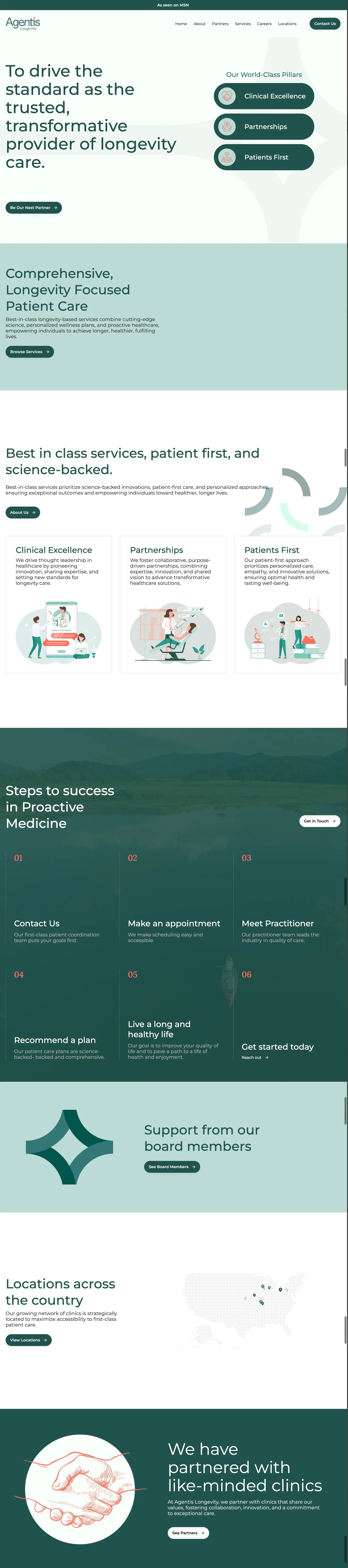
Agentis Longevity.
Agentis needed credibility fast. Their existing site was holding back conversion and the data layer underneath it didn't tell the truth. The team delivered a phased rollout: a fast surface refresh first to stabilize lead flow, then a full rebuild plus tracking infrastructure that gave clinical and marketing leadership the same view.
- Phase 01: surface-level refresh that stabilized hero, conversion paths, and trust elements without disrupting active traffic
- Phase 02: full rebuild on a modern stack, redesigned IA, clinical intake aligned to brand
- GA4, GTM, and CRM-routing rebuilt at launch so leadership acts on the same numbers
- Built sub-brand sites for companies under the Agentis umbrella as the portfolio expanded

More recent work.
Two more Shore portfolio projects from the last quarter. Same framework, applied to two different problem types — a fast brand-and-conversion redesign for Mantality, and ongoing CRO + measurement work for SLK Clinic.
Mantality Health

The legacy site lacked clear brand and differentiation — visitors weren't connecting with the practice. A modern, conversion-focused experience now competes in a crowded TRT market without sacrificing clinical credibility.
SLK Clinic

Zenoti's default booking buried clarity across multiple service lines. Custom modal flows ship visitors to the right calendar without confusion, with every modal wired through GTM and GA4 so reporting reflects real funnel steps.
Get Started.
When you're ready to engage, this is the form. It routes directly to PPG and the partner you select. The right person on the other end will reach out within one business day.
Tell us where you are.
Fill out the form below. Your message is shared with the PPG team and the partner you select. You'll hear back within one business day.
Got it. We'll be in touch.
Your message has been routed to PPG and the partner team you selected. The right person on the other end will reach out directly.